
Contact Lens Exams

What Happens at a Contact Lens Exam and Fitting
Contact lenses are medical devices. In other words, they can cause a moderate risk to eye health when used without appropriate physician examination. Contact lens evaluation is necessary for anyone who wishes to wear contacts or continue wearing contact lenses.
Contact lens fittings begin with a thorough eye exam. This will ensure an up-to-date prescription and rule out any pre-existing conditions that may prevent contact lens wear.
Our eye doctor will follow up the initial fitting to see how well your eyes are adjusting to the lenses or make any necessary changes in fitting or materials to provide you with the best possible fit. We educate our patients about proper contact lens care and the possible consequences if proper care is not taken. Looking ahead, we continue with long-term follow-up to monitor the condition of the lenses and to ensure that proper hygiene is being practiced.
During the contact lens exam, if you are a contact wearer, the exam begins with you wearing your current contact lenses. This allows the eye doctor to analyze how the eyes are functioning with the current contact fit and prescription being used.
We offer a wide selection of contact lenses such as daily, weekly, biweekly, or monthly disposables, as well as specialty contact lenses to fit each patient’s needs.
Following the initial fitting, most people adapt well. Many contact lens wearers find their contacts to be extremely comfortable for day-to-day wear, so much so that they do not realize they are wearing them throughout the day.
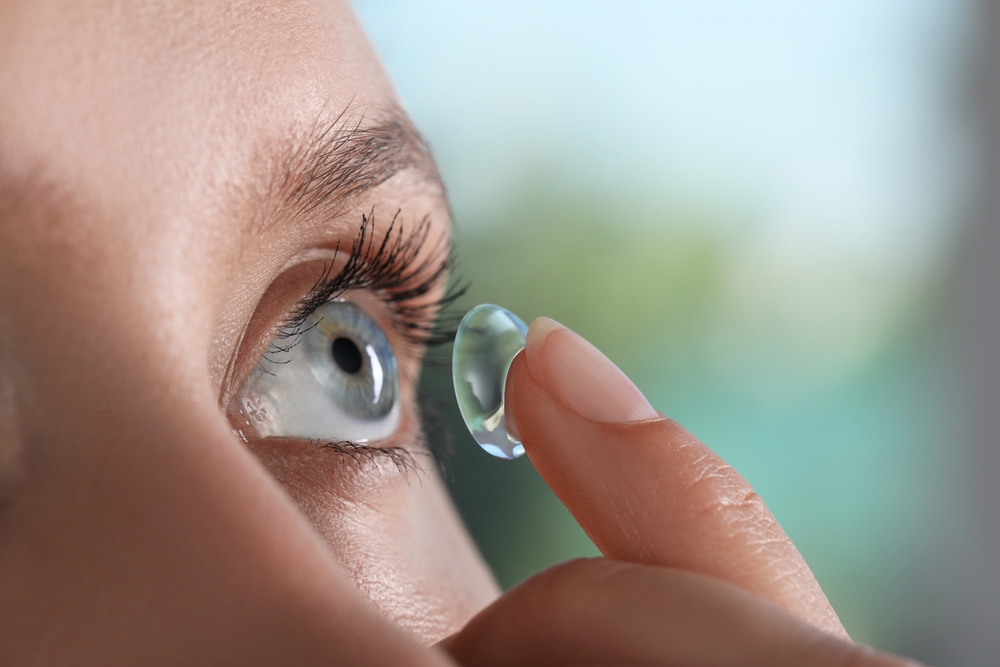
Types of Contact Lenses
Soft Lenses
Soft contact lenses are the most common type of contact lenses. They are made of soft, flexible plastic that allows oxygen to reach the eyes. Conventional soft lenses are used until they fail to provide satisfactory vision, comfort, fit or tissue response, which generally occurs after about 12 months of wear. Conventional soft lenses are worn during the day, and cleaned and stored at night. Usually once a week the lenses must be cleaned using an enzymatic cleaner, which removes protein deposits.
There are some advantages and disadvantages of wearing soft contact lenses. One of the advantages is that these lenses are very thin and flexible, making them extremely comfortable to wear. One of the disadvantages is that soft lenses absorb more of your tears, which traps more protein deposits from your tears and harbors bacteria. Depending on your prescription, your visual needs and your preferences, the doctor can determine which lenses are suitable for your eyes.
Disposable Contact Lenses
Disposable contact lenses are soft lenses that can be thrown away every day, weekly, bi-weekly or every four weeks. There are some advantages and disadvantages of disposable contact lenses. Some of the advantages of disposable lenses are that replacing lenses at shorter intervals prevents protein and other deposits from building up on the lens surfaces. This reduces the chance of eye health problems. Disposable contacts also reduce the chance of wearing damaged lenses. They are very easy to clean and disinfect and they are available in most prescriptions. Some of the disadvantages of disposable lenses are that most of these lenses are thin, so handling them may be difficult. Additionally, they do not correct all visual problems and vision may not be as sharp as with other types of contact lenses (e.g. RGP lenses).
For successful wearing of disposable contact lenses, it is recommended to adhere to the lens-wearing schedules. Carefully follow the schedule for discarding your used lenses and make appointments for follow-up care.
Extended Wear Contact Lenses
Extended wear contact lenses can be soft or gas permeable lenses. Most commonly, they are worn overnight or continuously for one to six nights, or up to 30 days straight. There are some advantages and disadvantages of extended wear contact lenses. One of the advantages is that they are extremely convenient, since contact lens wearers do not have to insert, remove and care for lenses on a daily wear basis. One of the disadvantages is that the use of extended wear lenses definitely increases the risk of sight-threatening complications when lenses are worn overnight. Extended wear contact lenses require closer monitoring and professional care. Frequent and thorough follow-up care every 3 months is critical in the proper care of an extended wear contact lens wearer.
Tinted or Color Contact Lenses
Tinted contact lenses allow patients to temporarily enhance or transform the appearance of their eyes. Color contact lenses are an appealing option. They provide a fun way to change up the patient’s appearance. They come in a variety of colors for both light and dark eyes. Tinted contact lenses are available with or without prescription but unfortunately, not all prescriptions are available. These soft lenses are available in conventional, disposable, or frequent replacement types.
Gas-Permeable (GP) Contact Lenses
Gas permeable (GP) contact lenses, also known as rigid gas permeable (RGP) lenses, are hard contact lenses made of silicone-containing compounds that allow oxygen to pass through the lens to reach the cornea. GP lenses offer a number of advantages over soft lenses.
Some of the advantages of the GP (compared with soft lenses) are that they provide a better oxygen supply than most soft lenses. Because they are custom-made to the shape of the eye, they hold their shape and move on the eye with each blink. This movement pumps oxygen-containing tears under the lens.
GP lenses last longer. Since they are made of a firm plastic, they do not tear easily. They are also easier to keep clean and do not need to be discarded frequently, unlike soft lenses. GP contacts have superior optics. Since they are firm, they retain their shape better when you blink, so your eyes don’t have to refocus as much. And they are very good for astigmatism or bifocal needs. In addition to their other advantages, new research suggests that GP lenses may slow the progression of myopia (nearsightedness) in some children. GP lenses are also used for orthokeratology, where GP specially designed contacts are worn during sleep to reshape the cornea and improve vision.
Some of the disadvantages of GP lenses (compared to soft lenses) are that they need a short adaptation period to fully adapt. Unlike soft lenses that are comfortable right from the start, GP lenses require some time to feel comfortable in the eyes. GP lenses are smaller, so during blinking the eyelids will experience initial “lens awareness”, but this is temporary: in a few days the lids will gradually adapt so that the feeling goes away with each blink. Additionally, because they are smaller than soft lenses, gas permeable lenses can slip off the eyes during contact sports or if the eyes are rubbed aggressively. GP lenses can have higher lens replacement costs. Since GP lenses are custom-made, they come in limited sizes, which makes GP lenses more expensive if you lose them.
For successful GP contact lens wear, it is recommended to take proper care of your GP contact lenses by following the care steps after each wearing period. This will increase comfort, help them last longer, reduce the risk of eye health problems and keep your lens-wearing experience enjoyable.
Toric Contact Lenses
Toric lenses are used to correct astigmatism. Toric contact lenses have a more elongated shape than standard contacts, and they are available in both gas permeable (GP) and soft types. However, soft toric contacts are much more popular and they provide clear and comfortable vision. Fitting toric lenses is a more complex process than fitting normal contacts. They usually require some trial and error until the doctor identifies a proper fit. Toric lenses are also available in various wearing schedules, ranging from daily disposable to extended wear.
Bifocal Contact Lenses
Bifocal contact lenses work similarly to bifocal eyeglasses. These lenses are designed with two distinct segments for different vision powers: one segment for distance vision and the other for near vision. This allows bifocal contact lens wearers to see clearly by switching focus from near to far as needed, though vision is not completely clear in between. Bifocal contact lenses come in both soft materials and rigid gas permeable (GP) varieties. Some can be worn on a disposable basis, meaning contact lenses can be discarded at specified intervals (even daily, in some cases) and replaced with fresh, new lenses. There are various designs and fitting strategies to suit each candidate who wishes to wear bifocal contact lenses.
Multifocal Contact Lenses
Multifocal lenses have multiple powers, including bifocals, trifocals or progressive lenses, all in one contact lens. Multifocal contact lenses have a range of powers that enable multifocal wearers to adjust their focus and see clearly not only at distance and near, but also in between. Multifocal contact lenses come in both soft materials and rigid gas permeable (GP) varieties. They are generally designed in one of two ways, as either simultaneous vision lenses or alternating vision lenses. Both designs aim to provide clear vision. There are certain factors that our doctor will consider when determining which is the appropriate lens for the patient.
Specialty Contact Lenses for the “Hard-to-Fit” Patient
Hard-to-fit contact lenses are for patients who have not been successful with regular contacts. Contact lenses are not an easy solution for every patient suffering from vision problems. Some eye conditions make wearing contacts a difficult task. This doesn’t mean these patients can't wear contact lenses. It just means patients need to discuss options with their doctor and obtain specialized, hard-to-fit contacts for their specific visual problems.
Some of the most common problems include:
- Keratoconus
- Corneal scarring; post-corneal transplant
- Dry eye syndrome
- Pellucid Marginal Degeneration
- Giant Papillary Conjunctivitis (GPC)
- Post-LASIK, or other refractive procedure
- Presbyopia
- Astigmatism
All Eye Care Services
See the full range of eye care we offer, from routine exams to specialty contact lenses.
Explore All ServicesHelpful Articles
Browse our patient education library by topic for more on keeping your eyes healthy.
Vision Therapy
Services
Contact Lenses
Eyeglasses
Eye Health
Surgical Procedures
- Benefits of LASIK
- Implantable Contact Lenses
- Limbal Relaxing Incisions
- iDesign Custom Lasik
- Am I a candidate for LASIK?
- LASIK Procedure
- Cosmetic Services
- Understanding PRK
- Which Patients are Good Candidates for Premium IOL
- Can Diet Reverse Diabetic Retinopathy
- Eye Disease Treatment
- Why Should You Consider Eyelid Rejuvenation
- LASIK Surgery
- Overview of Visian ICL
